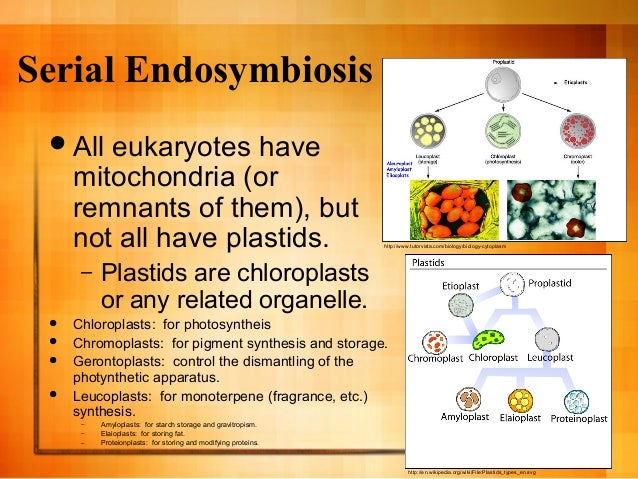
Serial Endosymbiosis. Chloroplast image courtesy of new mexico state university electron microscopy laboratory; Successive mergers (secondary endosymbiosis) added structural and functional features, such as new organelles, to the resulting cells.
Endosymbiotic theory (1) from www.slideshare.net
Lynn margulis describes the symbiogenetic processes in the lang. Our modern notions of symbiogenesis come from lynn margulis (sagan, 1967), who from the 1960s onward, has introduced the serial endosymbiotic theory (set) (sagan, 1967; According to set, certain primitive prokaryotes were engulfed by other, different prokaryotes.
Endosymbiosis Is A Term Used To Describe Two Organisms Living Together With One Inside The Other.
Lynn margulis describes the symbiogenetic processes in the lang. It was founded on the concept of symbiosis — from the greek ‘together’ and ‘living’ — which emerged largely from the study of lichens. The paradigmatic change is that the driving force behind evolution is not ramification but merging.
This Overall Scenario Was Later Dubbed The Serial Endosymbiosis Theory (Taylor, 1974).
The prokaryotic cells that live inside eukaryotic cells are called endosymbionts. Which process is an example of serial endosymbiosis? In ecology, symbiosis indicates that two different organisms live in association with one another, and nature abounds with.
Implications And Ex'tensions Of The Serial Endosymbiosis Theory Of The Origin Of Eukaryotes F.
Although a discussion of the origin of mitosis that margulis outlined comprises a substantial portion of her article, there is no evidence supporting it, in contrast to the proposed endosymbiotic origin of mitochondria and plastids. Updated on january 09, 2020. The endosymbiotic theory is the accepted mechanism for how eukaryotic cells evolved from prokaryotic cells.
Serial Endosymbiosis Theory The Roots Of Modern Endosymbiotic Theory Run Deep And Tangled.
Summary in comparison to other theories put forward so far, the serial endosymbiosis theory appears to be the most critically favoured as an explanation for the origin of mitochondria and chloroplasts. The serial endosymbiosis theory is a favored model for explaining the origin of mitochondria, a defining event in the evolution of eukaryotic cells. Further, the resultant organelles also share genetic information with the nucleus of the eukaryotic cell.
Use A Novel Statistical Approach To.
Successive mergers (secondary endosymbiosis) added structural and functional features, such as new organelles, to the resulting cells. It involves a cooperative relationship between two cells which allow both to survive—and eventually led to. Cyanobacterium image courtesy of the university of tsukuba institute of biological sciences.