How To Find The Implied Domain. I show how to solve math problems online during live. Or do you just look at the equation under the square root sign and find the implied domain of that, and that would be the implied domain of f(x) = √x2+3 f ( x) = x 2 + 3?
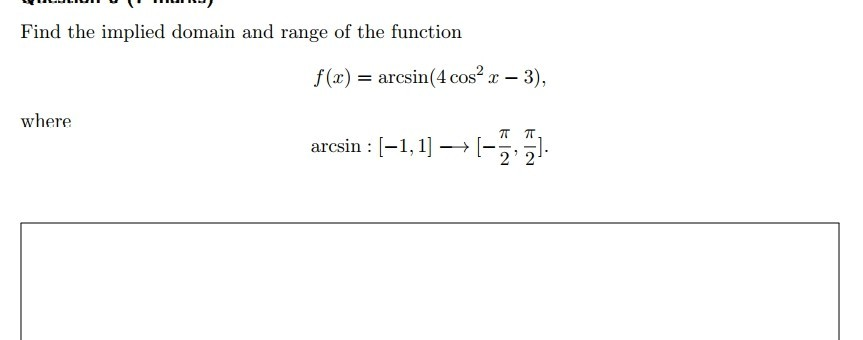
Find the implied domain and range of the function from www.chegg.com
The domain of a function is the set of all possible inputs for the function. To find the range you'll have to draw the graph. 👉 learn how to find the domain of a radical function.
Here I Show How To Find The Implied Domain.
The domain is a subset of that data restricted by a more or less arbitrary constraint. Factored we still set that equal to zero. Enter the function you want to domain into the editor.
What Is The Implied Domain?
Finding the implied domain of a function i show how to solve math problems online during live instruction in class. Therefore our domain goes from negative infinity up to negative the square root of three don't. To find the new domain of h we need to find when h(x) = 1.
In This Video We Will Explore How To Identify The Domain Of A Function Using The Restrictions, You Cannot Divide By Zero And Take The Square Root Of A Negati.
The domain of a function is the set of all possible inputs for the function. 2) what we’re talking about here is the implied (or maximal) domain, which is what you asked about. This function is not defined for x=0, but for every other x it’s ide.
This Is Called The Implied Domain Of.for Example, Is The Implied Domain Of Square Root Function.
This is my way of providing free tutoring for the students in my class and for students anywhere in the world. The implied domain is the largest possible subset of the real numbers where each member of the subset yields a real number when the function is applied. I know that to find the implied domain of y=arcsin(cos(x)) one must first find the domain of arcsin and then set up an inequation and solve for x.
Learn How Math Made Easy.
The domain calculator allows you to take a simple or complex function and find the domain in both interval and set notation instantly. When a function is defined, it is often the case that the domain of is not explicitly stated. To find the domain of this type of function, set the bottom equal to zero and exclude the x value you find when you solve the equation.