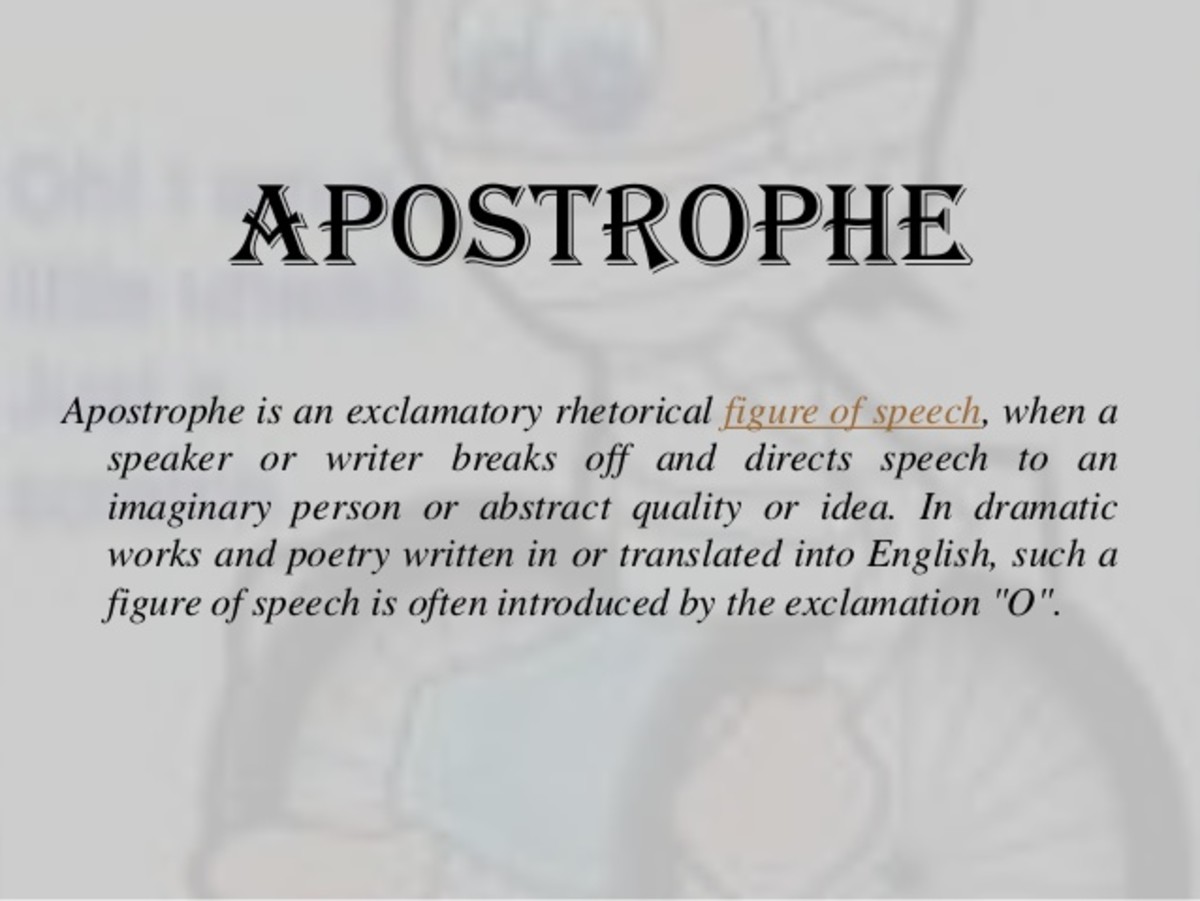
Apostrophe Definition Poetry. In english, the apostrophe is used for three basic purposes: Imagery, symbolism (including simile and metaphor), apostrophe, personification imagery the most common form of imagery in poetry is (1) visual imagery.
Apostrophe A Literary Device hubpages from hubpages.com
Also known as a turne tale, aversio, and aversion, apostrophes are more often found in poetry than in prose. In addition to being a punctuation mark, an apostrophe is a figure of speech in which some absent or nonexistent person or thing is addressed as if present and capable of understanding. It occurs when a speaker breaks off from addressing the audience (e.g.
As, Milton's Apostrophe To Light At.
This could be a person they know or don’t know someone who is alive or dead, or someone who never existed at all. Literary apostrophes are great for conveying emotion. Use apostrophe in a sentence.
It Often Involves A Change In Audience As The Speaker Stops Talking To One Person And Instead Addresses Another, Who Is Often Absent From The Story.
In A Play) And Directs Speech To A Third Party Such As An Opposing Litigant Or Some Other Individual, Sometimes Absent From The Scene.
An optimal learnin g circumstance and to facilitate learning on. In literature, apostrophe is known to be a figure of speech. Apostrophe is a rhetorical figure that is most commonly found (and thought of) in lyric poetry.
Apostrophe Synonyms, Apostrophe Pronunciation, Apostrophe Translation, English Dictionary Definition Of Apostrophe.
This means that the bulk of the word remains the same. Apostrophe, in poetry, is a figure of speech in which a character or speaker addresses someone who is absent. As a literary device, apostrophe is a poetic phrase or speech made by a character that is addressed to a subject that is not literally present in the literary work.
Similarly, The Definitions Given Below Aim For Practical Utility Rather Than Completeness.
Apostrophe noun a figure of speech by which the orator or writer suddenly breaks off from the previous method of his discourse, and addresses, in the second person, some person or thing, absent or present; This is a list of terms for describing texts, with an emphasis on terms that apply specifically to poetry, that appear most frequently in literary criticism, or for which dictionary definitions tend to be unenlightening. It occurs when a speaker approaching the breaking público (e.g., a game) and directs the speech to a third party, such as a adversã¡ria disputing or some other indivãduo the sometimes absent from